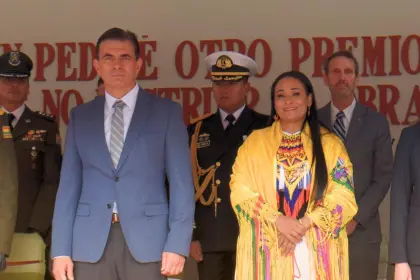
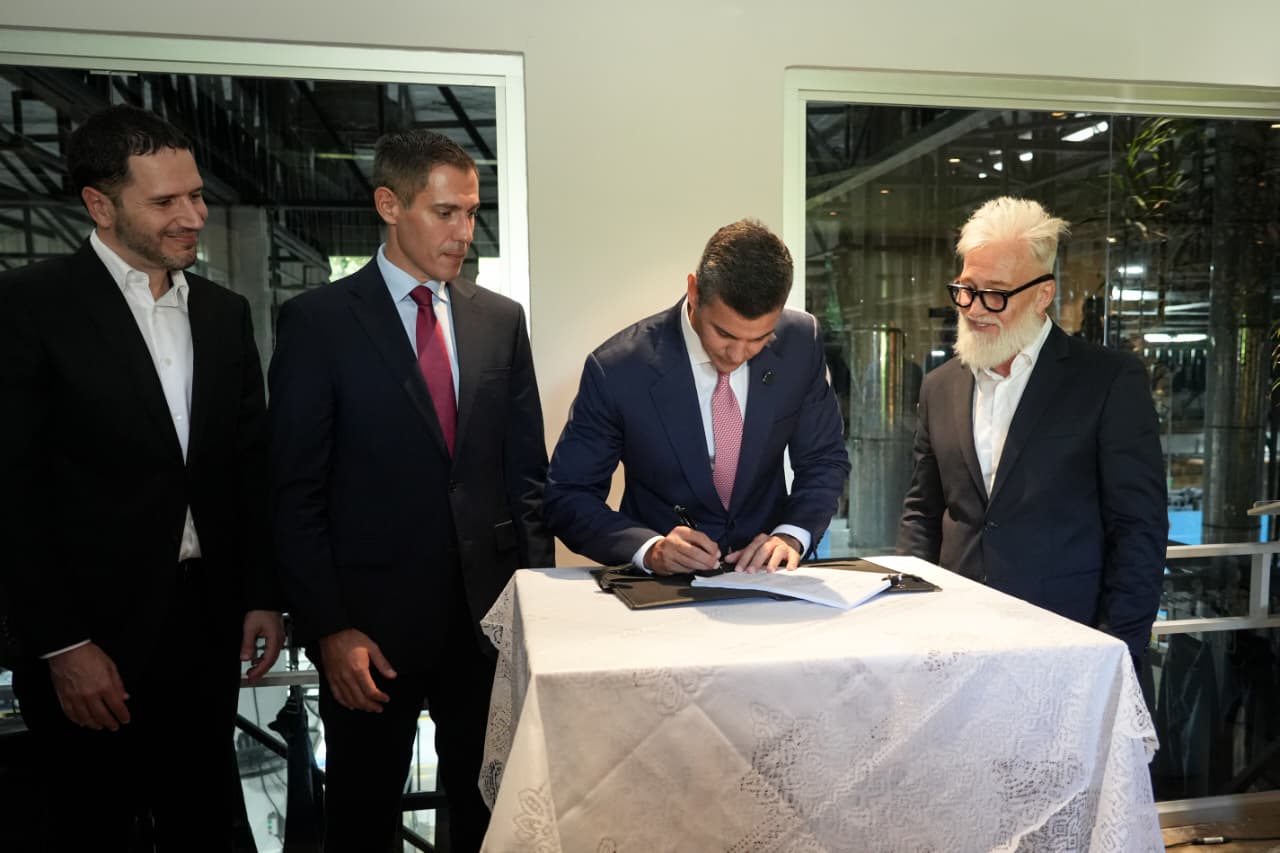
Asunción, Agencia IP.- President Santiago Peña signed today the implementing decree for the law, enacted last year, that updates the maquila system in Paraguay. “This is another step towards the Paraguay we want to achieve,” the President said at the ceremony held at a maquila plant in San Lorenzo.
At the signing ceremony, held at Blue Design’s facilities, one of the pioneering companies in Paraguay’s maquila system, the President stated that the maquila system is a powerful tool that significantly contributes to Paraguay’s transition to an industrial society.
He emphasized that the maquila sector has grown considerably in recent years, encompassing the textile, auto parts, food, and toy industries, but that the challenge is to aim for greater creativity and ambition, “because the best of Paraguay is yet to come.”
The implementing decree, signed by Peña, seeks to modernize the Maquila Regime, in effect in Paraguay since 1997, by incorporating services for export into the maquila regime and aligning it with global industrial demands, thereby strengthening investment attraction.
“This is a more modern law that will take us where we want to be, because what got us to where we are now isn’t necessarily what will take us where we want to be,” said the Minister of Industry and Commerce, Marco Riquelme.
In turn, the President of Blue Design and of the Paraguayan Chamber of Maquila Companies, Jorge Bunchicoff, stated that today marks a turning point for Paraguay.
“This decree is not just a formality; for me, it is a clear sign of confidence and direction. But it is also a commitment because the challenge now is not just to grow, but to grow better, with more added value, more knowledge, and greater integration into the world. And for that, we need to continue building together with clear rules, predictability, and a long-term vision,” he said.
He emphasized that today the maquila system generates formal employment, opens markets, and positions the country in places it wasn’t before, but stressed that the most important thing is that “it forced us to be better and understand that true development is not just about growth, but about growing while generating well-being and leaving no one behind.”
Finally, he highlighted that the presence of Paraguayan-made products in the world through the maquila system is not only a business achievement but also a sign that it is possible to produce in Paraguay, thanks to a shared vision of public policies that support the private sector.